Buying guide
How to get more storage in a small flat without building work
A small flat is rarely short of space. What it has too much of is dead space: the twelve-centimetre gap beside the washing machine, the hallway nobody dares put anything in, the metre of bare wall above head height. This guide is about turning those into storage, with the real measurements of each unit.
Disclosure: Abatible takes part in the Amazon Associates Programme. If you buy through our links we may earn a commission, at no extra cost to you. The scores do not depend on that commission. More detail.
The dead space in your flat, in order of what it pays back
Before buying anything, walk round your home looking for these three gaps. They are in almost every flat and almost nobody uses them.
1. The slot. The twelve centimetres beside the washing machine, between the fridge and the wall, down the side of a wardrobe. It is too narrow for furniture, so it stays empty for years. A unit on castors built for that width turns it into four shelves, and you pull the whole thing out to reach the back.
2. The hallway and the shallow wall. Anything under 25 cm deep passes in a hallway without making people turn sideways. Between 25 and 40 you notice it, though a wide hallway still works. Over 40 cm a normal hallway stops working. That is the whole rule.
3. The height. Low furniture is the worst deal per square metre in the house. A six-tier tower takes the floor of a chest of drawers and holds several times as much. With one non-negotiable condition, which is further down the page: fix it to the wall.
Our picks
Best overall
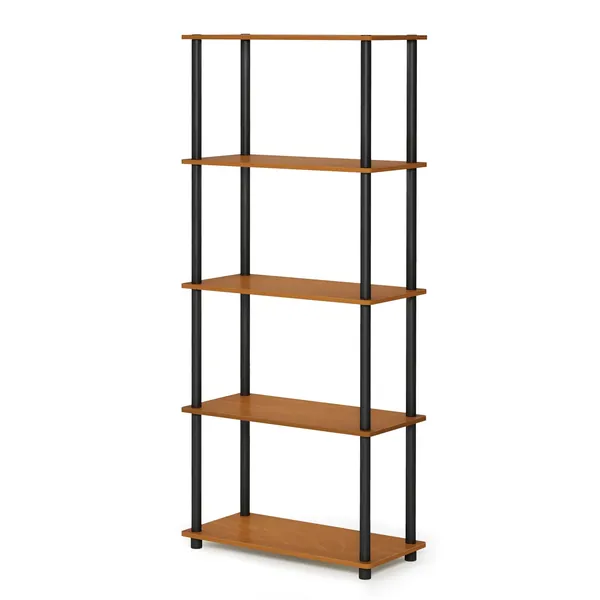
Furinno TURN-N-TUBE 5-Tier Shelf
The one that balances what it holds, how little it gets in the way, and what buyers say about it.
A 5-tier unit 59.9 cm wide and 29.5 cm deep that goes together without tools. 6.8 kg per shelf, 34 kg in total. 12,849 ratings averaging 4.4.
The shallowest
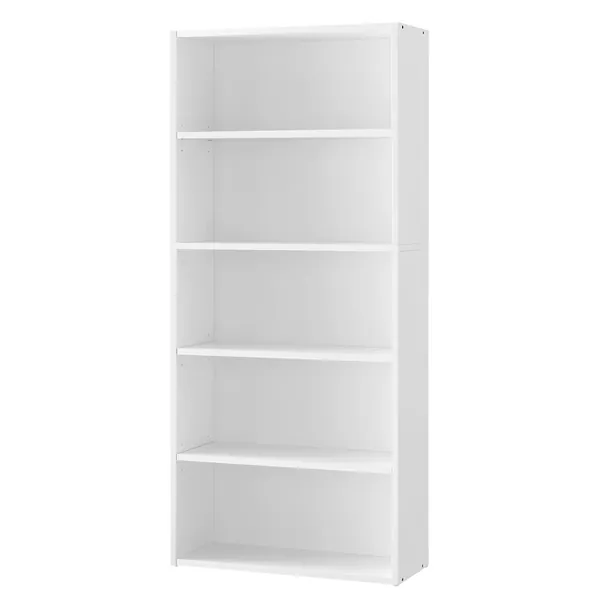
VASAGLE 5-Tier Bookshelf 60 cm
At 24 cm deep it goes where nothing else will: a hallway, the side of a wardrobe, the wall behind a door.
A 5-tier bookshelf 60 cm wide and only 24 cm deep, in 1.5 cm particleboard, taking 10 kg per shelf. Three of the five shelves adjust. 3,237 ratings averaging 4.6.
Best floor multiplier
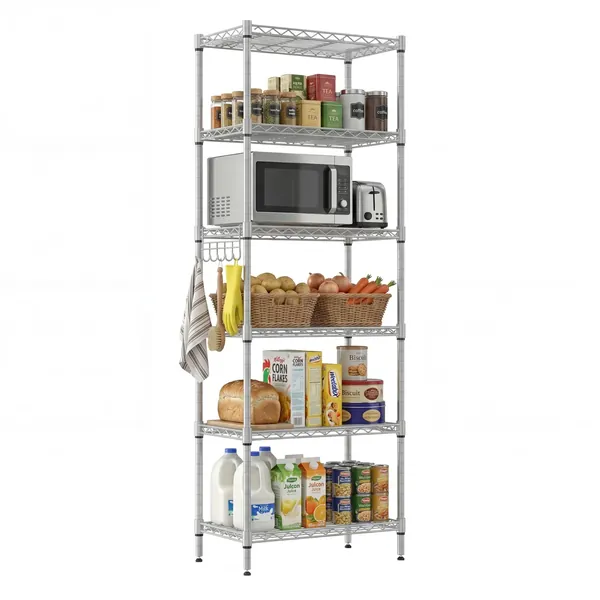
Himimi 6-Tier Wire Shelving Unit
Its 6 tiers turn every square metre of floor into 6 of surface to put things on. That is the whole idea of storing upwards.
Six powder-coated carbon steel wire shelves, 54 cm wide and 29 cm deep, taking 250 kg in total and adjusting in 2.5 cm steps. 2,960 ratings averaging 4.6.
Fix it to the wall. Seriously.
Anything tall and narrow is something that can go over, and the units here stand between 1.05 and 1.60 m on bases of 24 to 40 cm. Some include an anti-tip kit in the box and hardly anyone uses it. With children or animals in the house that is not a recommendation, it is the difference between a piece of furniture and an accident.
If you rent and cannot drill, buyers mention half-measures in their reviews, such as heavy-duty double-sided strips to hold the unit against the wall. It will not do what a wall plug does, but it stops a shove from tipping the thing over.
How much a shelf really holds
Watch the maximum load, which is the figure people ignore and then regret. Across these four it runs from 6.8 kg a shelf on a unit with plastic tube legs to 250 kg over the whole unit on powder-coated steel. That is not a small difference: one holds towels and paperbacks, the other holds tins, tools and a microwave.
And when a maker publishes no figure at all, assume it is low. One of these four does exactly that, and we say so on its listing rather than guessing a number for it.
Frequently asked questions
How deep can a unit be before it gets in the way in a hallway?
Twenty-five centimetres. Below that the unit disappears visually and nobody has to turn sideways to get past. Between 25 and 40 cm you notice it, though it still works in a wide hallway. Over 40 cm a normal hallway stops working.
Is a unit on castors worth it, or should I just buy a shelf?
It depends on the gap you are filling. A unit on castors makes sense when the space is too narrow to reach into: you pull the whole thing out, take what you need, push it back. For anything wide enough to see into, castors add cost and take away stability, and a fixed shelf holds more per tier.
How many kilos does cheap shelving really take?
The makers that publish a figure in this range declare between 6.8 kg a shelf and around 41, and the difference is the material: a frame of plastic tubes is at the bottom, powder-coated steel at the top, and thick particleboard in between. If a maker does not give the number at all, assume it is low.
Wire shelves or board shelves?
Wire carries far more weight and does not mind damp, so it is what you want in a utility room, a pantry or a garage. The catch is that anything small or soft-bottomed tips through the gaps, so you end up buying liners or boxes. Board looks like furniture and holds less, and it swells if the room is damp.
How do I know it will fit through the door?
Measure the narrowest doorway on the way to the room, not just the gap the unit is going into. Bathroom doors are usually the narrowest in a flat. Everything in this section arrives flat-packed and is built in the room, so the doorway only matters if you plan to move it built, which with a tall unit you will eventually want to do.
Compare them yourself
The products in this section set against each other, with the charts overlaid and the best value in each row marked.
Open the comparison toolSee the 4 products in shelving and vertical storage · All the guides