Buying guide
The best folding desk or table for a small flat in 2026
In a small flat the question is not which desk is best, but which desk disappears best. We have pulled the full listing for every model, normalised the measurements and worked out how much floor you get back when you fold it away. Here is what we found.
Disclosure: As an Amazon Associate I earn from qualifying purchases. It costs you the same, and the scores do not depend on it. More detail.
What actually decides the purchase
Almost every folding-desk comparison stops at the price and the open measurements. That is the least useful number of the lot. The difference is somewhere else.
Folded thickness is what decides whether the desk fits behind a door, in the gap between the wardrobe and the wall, or under the bed. Where makers publish it, the spread runs from 6.9 cm to 20 cm, and that gap is the whole argument: seven centimetres disappears, twenty has to go somewhere. Where a maker does not publish it, we estimate it and say so.
Depth comes second. It is what decides whether you work comfortably or with your neck at an angle. These run from 40 to 56 cm, which covers a laptop easily and one external monitor comfortably from 45 cm up.
Assembly is third, and it matters more than it looks: a desk you have to bolt together is a desk that, in practice, nobody ever folds. Two of these five need none.
Our picks
Best overall
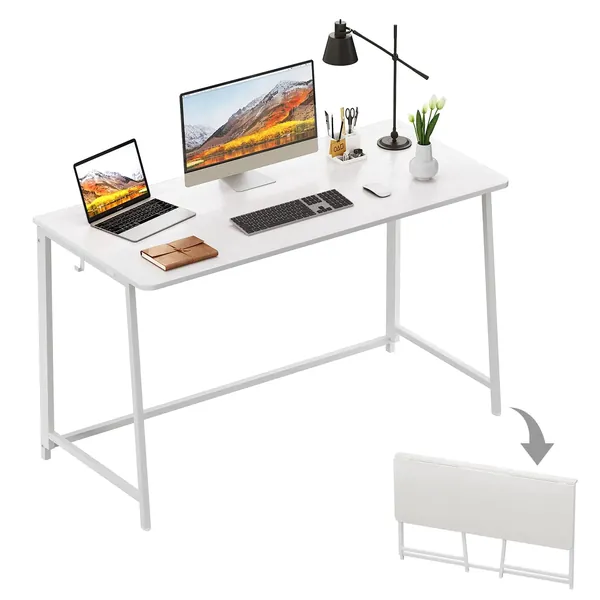
WOHOMO Folding Desk 120 cm
It scores highest once every criterion is added up.
A 120 × 50 cm folding desk with a metal frame and an engineered-wood top that, according to the manufacturer, weighs 10.7 kg and needs assembling before use.
Best use of space
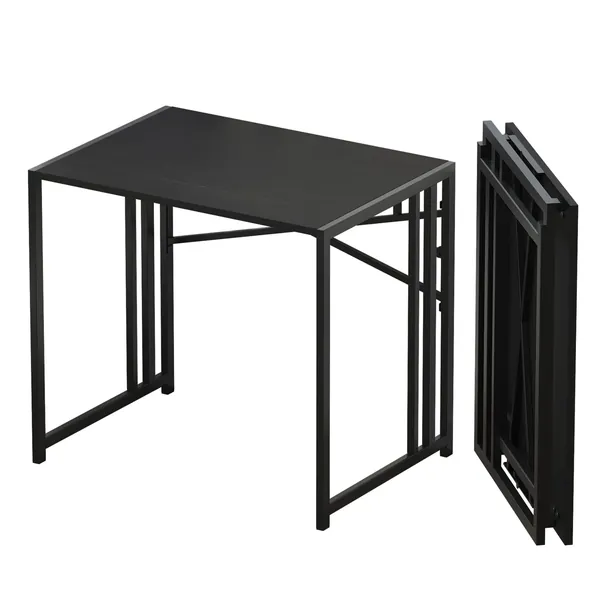
HOMCOM Folding Desk 81.5 cm, Monitor Shelf
If your problem is the desk being in the way when you are not using it, this is the one that takes the least off you once it is put away. The figure behind that is the folded thickness, and it comes from the manufacturer, not from us.
A folding desk that opens to 81.5 by 62 cm, with a monitor shelf fixed above the main surface. HOMCOM states a load capacity of 25 kg for the finished desk.

The shallowest
Lutown-Teen Folding Desk 83 cm, No Assembly
When the gap is 40 cm deep and there is no more, the conversation ends right there.
83 cm of width and it arrives assembled. The 40 cm depth is the catch: enough for a laptop, not enough for a monitor behind it.
How to measure your space before you buy
The most expensive mistake is trusting your eye. Take a tape measure and write down three numbers: the width of the free wall, the depth you can give up without blocking the way through, and the storage gap where the folded desk is going to live (behind the door, down the side of the wardrobe, under the bed).
That third number is the one almost nobody measures and the one that causes the most returns. With all three you can use our comparison tool: type in your centimetres and it marks the ones that fit.
One trick that works: mark the rectangle on the floor with masking tape and live with it for a couple of days. Seeing the space actually taken up, and having to walk round it to reach the window, tells you more than any spec sheet.
Frequently asked questions
How much depth does a folding desk really need?
At 40 cm you can work with a laptop without any trouble. Once you add an external monitor, 45 cm is the comfortable minimum: below that the screen sits over the keyboard and your neck pays for it. The deepest here is 56 cm. For two screens the width matters as much as the depth, and that means the 120 cm model rather than the 80 cm ones.
Which matters more, the price or the folded thickness?
Folded thickness, and it is not close. A desk that slides in behind a door and a desk that has to stand somewhere are different pieces of furniture, whatever they cost. Among the ones here that publish the figure it runs from 6.9 cm to 20 cm, so it is worth checking rather than assuming: a desk with castors and a shelf does not fold as flat as one that is just a top and four legs.
Is it worth paying for one that needs no assembly?
If it is going to stay put, it makes no difference. If the idea is to put it up and take it down often, it changes the whole experience: a ready-assembled desk opens out in seconds, whereas one you have to build means that, in practice, you will never fold it away.
Will they take a monitor and a desktop computer?
Few publish a maximum load at all. Where one appears, it is usually far more than any home setup will ask of it. Folding-leg desks like these are rarely short of strength. The real limit is not weight but lateral stability: most of them move a little if you lean on them hard. A thick metal frame tells you more than a high load figure.
How do I know it will fit before I buy it?
Measure the gap with a tape measure and compare it against the two figures on every listing: open and folded. In our comparison tool you can type in the centimetres you have and we will mark the ones that fit. Mark the floor with masking tape before you buy: seeing the real rectangle in your own room prevents almost every return.
Will it fit your gap?
Folding desks
The ones that fold to 10 cm or less
5 desks, with the length and height of the gap each one needs to be stored.
Compare them yourself
The products in this section set against each other, with the charts overlaid and the best value in each row marked.
Open the comparison toolSee the 8 products in folding desks and tables · All the guides